Archive for the ‘Exercise’ Category

Despite the ubiquitous pitch to trim down by most people who seek my services, I often get questions about how to successfully gain weight. Contrary to popular belief, gaining quality weight (without a subsequent increase in significant body fat) can require as much dedication as trying to reduce body fat while maintaining muscle mass. A big part of this conundrum circles around each individual’s somatotype (refer to “What’s your body type…or should I say Somatotype?”). It also comes down to having the right information. I gave 8 major weight gain tips in “quick tips to gain weight the right way”. The following tips compliment the 1st 8 and further assist anyone trying to gain quality weight:

1. Create a calorie surplus – gaining weight and losing weight honestly boil down to simply mathematics. To gain weight, eat more calories than you burn. To lose weight do the opposite. Without question though, you must eat big to get big. Since muscles are metabolically active they require a certain amount of cals to grow, more than that of non-metabolically active tissue. There are several recommendations of how many calories one should intake to gain weight, some based off fat free mass, some off entire body weight, some based in kg, others in lbs., etc. Generally, when counting cals, around 15-20 cals/lb. of bodyweight has worked well for me and people I’ve worked with. The exact number will of course vary by individual. Some hard gainers may need up to 25 cals/lb. of bodyweight to see any real weight gain. For others, its imperative that you keep an eye on your overall physique to make sure flab isn’t on the come up. If that happens trail back the cals/lb. of bodyweight. Also keep in mind the amount of cals you burn throughout the day will impact your recommended calorie intake as well.

2. To eat more, eat less – intuitively you may think hoarding cals into 3 huge meals will be the best way to ensure increased calorie intake. However, it’s actually easier on your metabolism, digestive system, and muscle growth to divide your daily calories into 5 to 7 meals a day. Eating big meals trigger extreme insulin responses by the body guaranteeing excess fat storage, lethargy and increased time between meals. Keeping consistent intervallic calorie intake allows for constant nutrient delivery to muscles and facilitates anabolism. Rule of thumb is to eat every 2-3 hours; time between meals and snacks shouldn’t exceed this.

3. Shake shit up – no matter how big you are, how ravenous your appetite, there’s only so much food you can eat in a day. Liquid cals are great for this purpose because they give you complete control over what you intake (homemade shakes), they are portable and easily accessible, and they digest quickly. One to two shakes a day can add a surplus of over 500 – 600 cals a day.

4. Quality over quantity (keep it healthy!!!) – “getting big” or “bulking” is not an excuse to devour gratuitous calories from junk foods. Poor diet choices destroy physiques; one or two cheat meals a week to keep you from losing your mind is fine, but make healthy foods the foundation of your diet. Beware the cheat day! One cheat day can cancel out a whole week of hard work.

5. Low carb, no carb, no way! – Carbohydrates fuel exercise and will give you the energy to lift big. Complex, low glycemic, slow digesting carbs are best (quinoa, rolled oats, whole grain cereals). The exception to the rule is post workout where your meal should be filled with high glycemic, simple, fast digesting carbs to replenish energy lost during exhaustive exercise (juice, white potatoes, dextrose).

6. Get enough protein – protein/amino acids are the foundation for muscle growth. 1 – 1.5g/lb. of body weight for mass gain (up from the normal .8 recommendation for the average person). Aim for high quality high bioavailable proteins from varying sources to ensure adequate amino consumption.

7. Get enough fat – fat provides more cals than protein or carbs making it an easy way to increase calorie intake. It also helps keep testosterone elevated for muscle growth. Aim for polyunsaturated fats (flax seed, salmon, walnuts) and small amounts of sat fat (beef and dairy). Avoid trans fats (processed, baked and fried foods).

8. Post workout – eating the proper meal in a proper window (2 hours or less) after exhaustive exercise maximizes recovery and anabolism at a time when your body is most primed for nutrient uptake: Ingest high glycemic carbs with high quality protein (refer to “A Summary of Macronutrients”)

9. Preplan for success – maximize efficiency and reduce missed opportunities by using downtime to prepare meals in advance. This reduces the likelihood of ingesting unhealthy non-progressive food due to lack of time or lack of options.

The glute maximus is the largest muscle of the gluteal group and arguable the strongest muscle in the body. It inserts into the IT band so it is responsible for hip and trunk extension as well as lateral rotation of the leg and hip. The responsibilities of the glute maximus make it vital in the performance of everyday activities like jumping, standing up from a seated position and bending over. However, present day sedentary lifestyles involve more sitting and less physical activity. Sitting on the glute maximus for extended periods of time keeps the glute maximus under constant tension and pressure. This, over time, causes a shortening of the muscle leading to glute maximus weakness. Weak glute muscles force other muscles in and around the hip complex to work harder. The resulting overcompensation from surrounding muscles increase the risk of injury because these muscles end up doing more than they are supposed to (synergistic dominance).
Due to the interconnected nature of the body, compensations near the site of weakness (the gluteus) can lead to compensations farther away from the site of weakness leading to injuries as part of a “cumulative injury cycle”. Two muscle complexes particularly vulnerable to injury post gluteus maximus weakness are the hamstrings and the adductors. When the glute maximus is weak the hamstrings become overactive trying to control and facilitate the extension and rotation of the leg and hip (especially the biceps femoris/lateral hamstring) leaving them prone to overstretching, strains and tears. The adductors are also at increased risk because they are more heavily recruited during sharp movements in order to try and control pelvic flexion, a job typically done by eccentric activity of the gluteus maximus.
Most sports that incur increased hamstring and adductor (groin) strains typically involve swift motions of the leg and hip as well as sharp changes in speed and direction (ex: football, basketball, soccer). The best way to prevent these injuries is to incorporate stretching and to facilitate proper muscle activation of all the musculature in and around the hip complex. Most people don’t properly train because they don’t know how to spot glute weakness since the body compensates for it so well. The best program to ensure gluteal activation includes unilateral exercises that require hip extension and leg abduction and external rotation (ex: 1 legged dead lift, 1 legged squat, 1 legged step up).

Im bbbaaaacccckkkk…with the facts to help you get your act back on track….lets get right into it…

Truth: the best way to start off in the gym is to have a goal. Dedicate yourself to the goal. Be consistent. It doesnt matter if your goal is to lose 100 lbs or to play for the Knicks (although playing for the Knicks might be easier since they are seemingly letting anyone play now a days…)

Truth: Im fairly confident when I say no one EVER, in the history of everdom (yes…everdom), has reached their goal by slowly pedaling on a recumbent bike while playing words with friends #stopit

Truth: most gyms have horrible music = only like 1 song out of every 10 actually belong in a gym and not in a country jamboree, a club in lower east side manhattan or playing in the background during a fight on Love and Hip Hop. Just bring your own music and chill with all that noise (no pun intended)

Truth: don’t fall for gimmicks…seriously the only way to really lose 10 pounds in 72 hours is by having really bad food poisoning (not recommended)

Truth: yes…every gym has an over enthusiastic trainer that needs to sit down somewhere #fact, every gym has an overenthusiastic member that makes a whole bunch of noise to make his lifting of 30lbs sound like hes military pressing 300lbs #fact, and yes every gym has that strange guy that lurks in the shadows…just when you think he’s not there…he pops up in the corner by the dumbbells with the Charlie Murphy look on his face #superfact

Truth: every gym has two types of members…those that actually wipe down machines and put weights back…and those that are the worst people on the planet…the ones who make you feel guilty about the ill will you find yourself wishing upon them.

Truth: “recovery energy bar with antioxidants and dark chocolate, the perfect after workout snack thats good and good for you” = chocolate bar on steroids

Truth: you should always beware of that guy in every gym that offers unsolicited advice, you know the one who looks flabby and sick but takes 45 min to tell you why you should be lifting like 100lbs over your max so that you can look like him

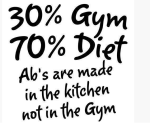
Truth: you can take 10 min abs, 20 min abs, bootcamp abs, burn baby burn abs, get ripped abs or you can try one that actually works…the stop eating pizza, pastries and popeyes abs…

Truth: if a gym class is going to be effective it has to be difficult, so if your relaxed and enjoying yourself you’re just in a big babysitting class for adults

Truth: its not practical to buy $150 dollar sneakers, $100 dollar tights and $5 voss waters to workout and then complain about how healthy food “costs so much”…”yea but you have them new Nike Max Airs doe…” #fail

Truth: thinking about going to the gym burns between 0 and 0 calories…per minute!!!!!! Thats crazy…

Truth: “a gym membership is alot like a marraige…if its good you show up committed and ready to put that work in…if its not, you show up in sweatpants and watch alot of bad tv” -j. gay

Introducing Willgetyoufit Sports Specific Training powered by Combine 360…no matter what your game, when competition is your sport, Combine 360 training is the wave of the future neatly wrapped in a gift box with an “Open Me Now” note attached!!! Combine 360 Training powered by Under Armour, Gatorade, and Trx (to name a few) is a style of training scientifically designed to improve an athletes’ athleticism, overall movement and character to make them and all around better threat on and off the field, whether in sport or in life. Its a fool proof way to get #BetterEveryDay. Every athlete that I train comes to understand that what a man lives are his convictions, and we live to get better ever day because in our eyes if you aren’t getting better than you’re just getting worse. #Progressneversleeps is the mindset my athletes adopt because the will to succeed is wonderful but the will to prepare…that’s what gets you to the top.(Bobby Knight) #Hardworkpaysoff is what my athletes believe because we know greatness can only come when talent is backed by hard work. We live our lives to echo our training and our training allows us to be at our best when our best is needed. If you feel like you could be better at your sport, if you feel like you’re good but not great or even at the top of your game but feel like you could still progress, this is the team for you. To join shout me out willgetyoufitnyc@gmail.com or hit me on my combine page. We bring it all day, everyday, and the day after. Together, we will be the reason the world remembers #Hardworkpaysoff…

Special Shout Out To:
Coach Trevor Anderson
Stacey Daniels
Michael Torres
Michael Labuanan
Real Deal Oneil
*These people inspire me to keep pushing…

Willgetyoumotivated…

Posted: December 19, 2011 by williampower in Exercise
Tags: , , ,

What often gets overlooked is the fact that the amount of physical exercise exerted during a days time directly influences the quality of sleep you experience at night. The more active you are during the day the more relaxed you typically are at night and the more likely you are to fall asleep faster. The transitions between sleep cycles are also expedited when one participates in exercise regularly. Exercise is also known to reduce the incidence of stress which is a known impedance to falling asleep in a timely manner. By being consistent with your exercise regimen, you may find it easier to deal with your stress and in turn have less obstacles in the way of falling asleep. Just a reminder however, this physical activity should not take place 3 to 4 hours before bed due to the fact that exercise (when done right) puts your body in an excited state for a few hours after the workout is done. During this excitement phase it is usually difficult to fall asleep. This is why the ideal time to work out is in the morning, afternoon or early evening. The ideal timetable for the average person is 3 to 4x a week for a period of about 45 minutes in succession. These minutes can be broken up into periods of no less than 10 minutes but exercise done in succession yields the best results. If you are battling not sleeping, you’ll find aerobic exercise to be the best.

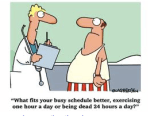
Your goal with exercise is to increase the amount of oxygen that reaches your blood stream. If you discover that you don’t have any time to exercise on a regular basis, you should try to sneak moments of activity into your schedule. Whenever possible, you should take the stairs instead of the elevator or park your car around the corner and walk that extra block or two to get to your destination. There are many small things you can add to increase the activity in your life. Your overall goal here is to have a healthy and well balanced life with plenty of sleep.

1. Commitment to the cause: Now is the right time. Your life is busy and full of stress and it will probably always be. Ask yourself, if you were sick, would you postpone feeling better for a month or two? Doubt it. This should be alon those same lines of thinking, make the commitment to yourself to start feeling good and lose those extra pounds today. In the words of Terry Guillemets…”tomorrow is disease”.

2. Cardio: Plan three 30- 45 minute aerobic workouts into your schedule each week. Don’t leave it to chance that it will fit in because then it won’t. It can be walking, biking, or even a class. Just get your heart rate to 60 – 75% of your maximum heart rate.

3. Weight Training: Try and maintain two workouts per week into your schedule. This time investment will help you build and maintain muscle. The more muscle you have and the more efficiently they work, the more calories you will burn all day long with less effort. For those of you worried about getting too muscular, stop it. First of all you would need to be genetically predisposed to have large muscles and second you would need to take in a lot of extra calories which is the opposite of what we are trying to do here. But, to play my own devil’s advocate, lets say you find yourself “too muscular”, then that means you succeeded in losing that extra unsightly bodyfat that you were trying to lose, and at that point you could just cut back on the weight training.

4. Hydration: Water is involved in everything the body does from your joints to your liver (which is the organ that metabolizes fat). The rule of thumb is eight, 8-oz glasses of water per day. This sounds simple, but most people that I come across who diet and exercise regularly and still can not lose weight are under hydrated. Best solution, only drink water or tea. Eliminate all those calorie laden bevegaes out your diet (allowing you to cut calories) and replace them with water (increasing your water intake). You know what that’s call…#winning!

5. Eat 5 – 6 Small Meals Per Day: Why? Because this technique will increase your metabolism and energy levels. It will also curb that hungry feeling which leads to cheating. This technique will train your body to stay in a constant food burning mode with a steady, but not overabundant flow of nutrients.

6. Balanced Meals: This means you need to have some protein and fat with carbohydrates at each meal. Both protein and fat reduce the glycemic index of carbohydrates, so you won’t get a big, fat-producing insulin surge. High GI foods (simple sugars, fat-free treats, and highly processed foods) cause a rapid increase in blood sugar levels – which causes a big insulin release to shuttle the excess blood sugar into cells. Remember, whatever isn’t used by the body at that point in time is stored as fat.

7. Limit Fats and Simple Carbohydrates: One way to do this is to eat less processed foods. But, this isn’t always possible, so pay attention to what you are eating. Read labels, if more than 20% of the calories comes from fat, don’t eat it. Eat fiber rich breads (if any…I don’t recommend bread intake) and cereals, they will fill you up faster.

8. Limit Eating Near Bedtime: If possible, try not to eat two hours before turning in for the night. Most people are not as active after their evening meal as they are earlier in the day. It is best to keep the total calorie level, as well as carbohydrate level, lower in your later meals. This will prevent extra fat storage that would occur as we sleep.

9. Eat it. Drink it. Write it.: Write down everything you eat and drink in a log. This will keep you honest, and help you plan. It has been said, “the act of recording history, changes history”? By writing down your food intake, you will see where you have been making mistakes and it will make you think about it before you make that the same mistake again.

10. Reward: Give yourself a reward when you achieve certain goals. Maybe a new outfit (because the other ones are getting baggy). Acknowledge the hard work you have done and the success you are achieving. #Hardworkpaysoff.

A lot of people are afraid of strength training because of the influx of misconceptions that are so abundant in the world on non avid workout enthusiasts. The fact of the matter is strength training benefits everyone no matter what age or gender. So to make it less of a fear invoking past time, I’m going to dispel a few misconceptions that plague the minds of those who aren’t in the know.

Crap Fact #1: Strength training will bulk you up, and women who strength train will lose their feminine appearance if they do it. This is probably the most traduce statement about strength training. Saying strength training will bulk you up is like saying studying physics will make you Einstein. Yeeeaaaaa…doubt it.
Real Fact: Strength training will make you stronger. It doesn’t give you bulky, masculine-looking muscles unless you have a lot of testosterone circulating in your blood. The amount of time, food and discipline it takes to get huge from weights is almost a full-time job (trust me) and sometimes it’s influenced by illegal substances. Unless a woman is using anabolic steroids, she will not develop bulky muscles; she will develop strong muscles.

Crap Fact #2: “No pain, no gain”
Real Fact: Some localized muscular soreness that dissipates over a couple days can indicate that you worked hard. However, in the grand scheme of things, a sign of a good workout is results, not soreness. Therefore, your goal should be results, not post exercise pain.

Crap Fact #3: Strength training doesn’t help with weight loss.
Real Fact: Although strength training doesn’t burn fat like aerobic exercise does, it certainly does help with weight loss. As your muscles get stronger, denser and work more efficiently, your resting metabolic rate increases. Which means that you burn more fat, even when you’re not exercising #winning

Crap Fact #4: Kids can’t do strength training because it will stunt their growth.
Real Fact: Age-appropriate strength training is recommended for kids to help them develop strong muscles and bones and avoid obesity, which is so prevalent among so many children now a days. It does not stunt their growth.

Crap Fact #5: Old people shouldn’t strength train.
Real Fact: Strength training helps older people maintain muscle strength and bone density as well as helping them maintain balance, and preventing falls.

Crap Fact #6: Working out on an empty stomach burns the most calories.
Real Fact: No it doesn’t. Stop it.

Crap Fact #7: If I want to look like my favorite celebrity than I should mimic their workout.
Real Fact: Trying to look like someone else is futile unless you are his or her identical twin. Put your energy into perfecting YOUR body and its mechanics. Envy will do nothing for you but produce negative energy. However, inspiration is clutch for motivation. So it’s not a problem using athletes and celebs as fuel, just make sure your goals are personal.

Crap Fact #8: Master Cleansers are healthy.
Real Fact: No! They aren’t! Science and history has shown us time and time again that our liver and kidneys are more than sufficient enough to detoxify our body of any toxins or pollutants that we may have ingested. In my experience, people who do master cleanses typically end up worse of than they started. Leave the short cuts alone. Stay consistent, stay true and work hard and you will see that hard work pays off.

Crap Fact #9: Cutting carbs will make me lean.
Real Fact: No, it will make you mean, weak and irritable. Carbs are the body’s most efficient energy provider and without it your body is merely compensating to survive. Eventually the sacrifices of that compensation are going to catch up to you and it wont be pretty. Consume more fruits, veggies and legumes and weight gain from carbs will be a minimal issue.

Crap Fact #10: I have to train for hours on end to get results.
Real Fact: No you don’t, not at all. It depends on the intensity of the exercise you are doing. If (hypothetically speaking) running for 20 mins burns 200 cals and walking for 50 min burns 200 cals and I’m on a timetable…which choice is the best choice? Need I say more? Step your game up…

1. Improve athletic performance. Abdominal muscles play a pivotal role in all physical activities where you need to run fast or twist your torso.

2. Protect the spinal column and support the spine. Weak abdominal muscles and excess belly fat (adding weight to the front of your body) put your intervertebral discs in a very precarious position, increasing the risks for slipped discs and lumbar degeneration.

3. To relax tense muscles. For a number of people, during the night hours, the lumbar muscles can stay tense reflecting a long day of compression. That means upon wakening one often arises tired and with slight to moderate back pain. This is a sign that during sleep your spine did not relax and recuperate properly. A few minutes of core exercises before bed can aid in relaxing the lumbar muscles and releasing the pressure it is subjected to throughout the day.

4. Reduce the likelihood of several metabolic diseases like Type 2 Diabetes. Most of these diseases can be linked to excess belly fat.

5. Augmenting digestion. Efficient abdominal muscles help facilitate digestion helping to prevent constipation and bloating.

Introducing Tamar Adams and Brian Hutchinson, 2 of #TeamHardWorkPaysOff’s “starting 5” and 2 men that understand that #Hardworkpaysoff…”Success doesn’t come to you, you go to it…”